
Using Images on Your Website Legally
Most Kenyan business owners never think about using images on your website legally until the letter arrives.
It comes by email, and it is very calm.
One photograph on your website is named. The letter states when the image was found, where it appears, and who owns it. Then it names a figure, often far larger than the licence would have cost, and gives you a deadline.
Nobody warned you, because the person who built your site pulled that photograph from a search results page two years ago and nobody has thought about it since.
Using images on your website legally is not complicated. However, almost nobody explains the rules to small businesses until the rules arrive with an invoice attached.
Why It Was on Google Is Not a Defence
Search results are an index of what exists online. Appearing there says nothing whatsoever about whether you may use something.
Copyright attaches automatically the moment a photograph is taken. No registration is required, and no copyright symbol needs to appear anywhere. In Kenya this sits under the Copyright Act, administered by the Kenya Copyright Board, and the principle holds across almost every country your visitors might come from.
So the absence of a watermark means nothing. Neither does crediting the photographer, because credit is not permission. Cropping changes nothing either.
Stock agencies also find these uses automatically. Reverse image search runs continuously across the web at scale, matching licensed photographs against pages using them without a licence. Consequently, a small Kenyan business site with modest traffic is just as discoverable as a large one.
Where Your Images May Legally Come From
Using images on your website legally comes down to four sources, listed here in rough order of safety.
Photographs you took yourself. You own them outright. For most service businesses these also perform better than anything you could buy, because clients recognise a real premises and real staff. Our post on professional photography for websites covers commissioning a session.
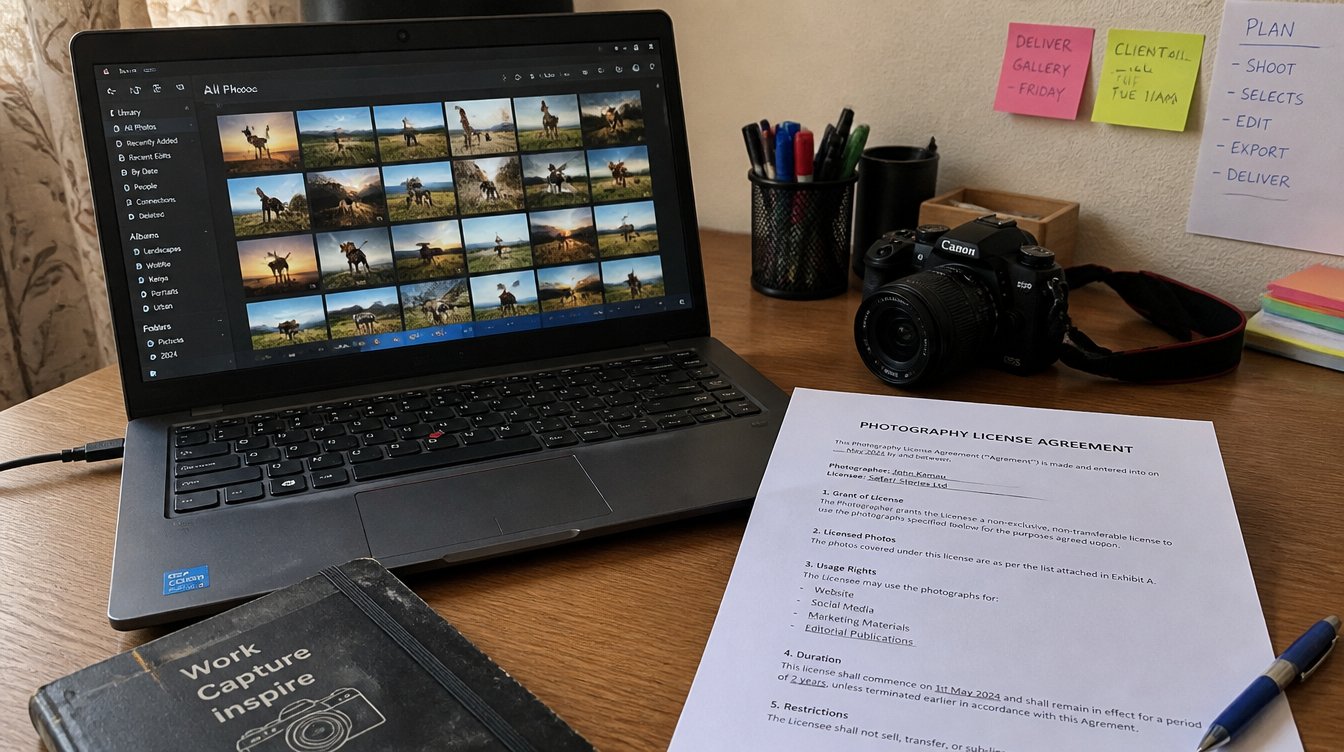
Photographs you commissioned. Safe, provided your agreement actually assigns the rights or grants a broad licence. Photographers frequently retain copyright by default, so the contract matters. Ask for commercial usage in writing.
Licensed stock. You pay an agency, you receive a defined licence, and you keep the receipt. Boring and reliable.
Free licence libraries. Unsplash, Pexels, and Pixabay allow commercial use under their own terms. These are genuinely useful, although the terms carry limits worth reading rather than assuming.
Reading a Licence Without a Lawyer
Four phrases cause most of the confusion.
Royalty free does not mean free. It means you pay once rather than per use. Many people see the word free and stop reading, which is an expensive misunderstanding.
Editorial use only permits news and commentary, not promotion. An editorial image on your services page is a breach, even though you paid for it.
Extended licence covers uses the standard one excludes, typically merchandise, resale items, or very large print runs.
Non commercial appears in Creative Commons licences marked NC. Your business website is commercial, therefore those images are unavailable to you regardless of how the page looks.
Creative Commons has several variants, and the differences matter. Anything marked CC0 is effectively unrestricted. Attribution in a specified form is required under CC BY. Meanwhile CC BY-SA additionally obliges you to share adaptations under the same terms, which surprises people regularly. Read which variant applies before downloading rather than afterwards.
People in Photographs
Using images on your website legally involves a second question beyond copyright. Copyright covers who owns the photograph. It says nothing about the rights of the person standing in it.
Where somebody is identifiable and the image promotes your business, you generally need their permission. Stock agencies handle this through model releases, which is one reason licensed stock costs money. For photographs you take yourself, get written consent, and be specific about where the image will appear.
Kenya adds a further layer. Under the Data Protection Act 2019, a photograph of an identifiable person is personal data. Images of children attract stricter treatment still, and the Office of the Data Protection Commissioner has issued substantial penalties over pupil photographs published without parental consent. Our guide to data protection for websites in Kenya covers the obligations.
Property can matter too. Some buildings, artworks, and interiors carry their own restrictions on commercial photography.
The Traps Nobody Mentions
Using images on your website legally covers more than photographs, because images are not the only thing on a page that somebody owns.
Logos. Displaying a client’s logo needs their agreement. Displaying a brand you have no relationship with implies endorsement you do not have.
Screenshots. Generally acceptable for genuine commentary or instruction. Considerably less so when used decoratively across a marketing page.
Maps. Embedding a map through an official service is fine. Screenshotting one and treating it as an image is a different matter.
Fonts. Web fonts carry licences, and some free desktop fonts are not licensed for websites at all.
Icons. Many icon sets require attribution somewhere on the site, which teams routinely forget during a redesign.
AI generated images. Ownership and copyright here remain genuinely unsettled in most jurisdictions, and the position is still developing. Read your generator’s terms, avoid prompting in a named living artist’s style, and treat anything resembling an existing character or brand as unusable.
If a Demand Letter Arrives
Take it seriously without panicking, and remember that using images on your website legally is a fixable problem rather than a catastrophic one.
Do not ignore it. These rarely disappear on their own.
Take the image down immediately, and check whether it also appears on your social channels, in old blog posts, or in cached versions.
Find your evidence. Search for a licence, a receipt, or an email from whoever supplied the image. A valid licence usually resolves the matter quickly.
Check the claim is genuine, since fraudulent demand letters do circulate. Verify the sender independently rather than through links in the message.
Take proper legal advice where the figure is significant. Amounts are frequently negotiable, and an advocate will tell you what is reasonable in your circumstances.
Audit What You Already Have
Most Kenyan business websites have never been checked. An afternoon now costs far less than a letter later.
List every image on the site, including blog posts and older pages. For each one, note where it came from and whether you can produce a licence or receipt. Anything you cannot account for should be replaced.
Pay particular attention to images added by former staff, freelancers, or previous developers, because those are the ones with no paper trail. Ask your current developer where each image originated, and keep the answers.
Then create a simple record for future images. Source, date, licence type, and a link to the terms. Using images on your website legally becomes effortless once that habit exists, and impossible to reconstruct once it does not.
Frequently Asked Questions
Can I use a photograph if I credit the photographer? No. Credit is not permission. Attribution is required by some licences in addition to permission, never instead of it.
Are Unsplash and Pexels images safe for a business website? Generally yes for commercial use under their terms, although limits apply and terms change. Read the current licence and save a copy of it.
What if my developer added the images? You are the one publishing them, so the exposure sits with you. Ask where each image came from and keep the documentation.
Does using images on your website legally apply to social media too? Yes. The same copyright rules apply to your Facebook page, Instagram posts, and anything else you publish.
Can I use a photograph I found on a competitor’s site? No. They may not own it either, and copying it exposes you to the original owner regardless.
Is a small business really at risk? Detection is automated, so size offers no protection. Kenyan businesses do receive these letters.
Use Your Own. Document the Rest.
Using images on your website legally is simplest when the images are yours. Photographs of your actual work, premises, and team outperform stock imagery for credibility, and they carry no licensing risk at all. Where stock genuinely serves the page better, buy it properly and keep the receipt.
At Africa Web Experts we use properly licensed imagery and tell you exactly where every photograph on your site came from. Websites from KES 65,000, live in seventy two hours, on your own domain.