
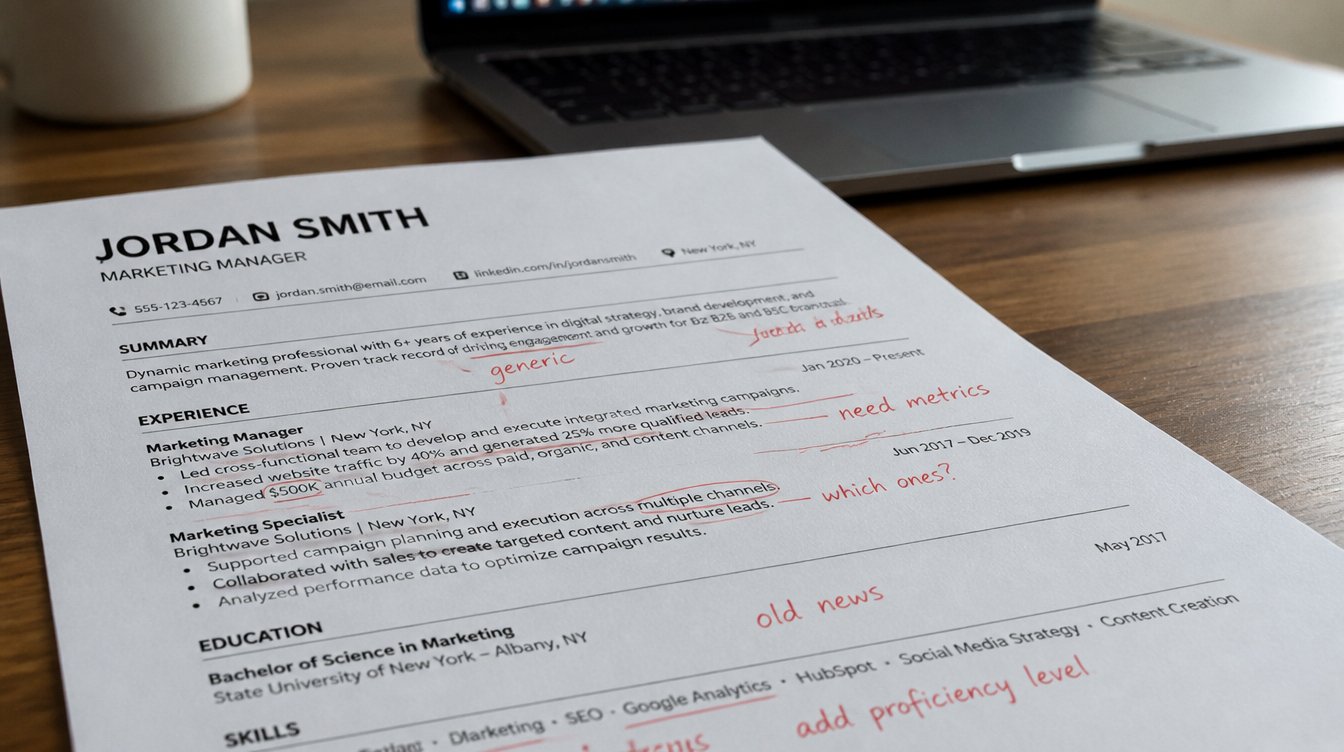
Turning a CV Into a Consulting Website
Plenty of people turn a CV into a consulting website over a single weekend, and the result reads exactly like what it was made from.
Somebody leaves a senior role after fifteen years, decides to consult, and opens a page builder on Saturday morning.
By Sunday evening there is a career summary, a list of employers, responsibilities written in the passive voice, and an education section near the bottom. It is accurate, professional, and it wins nobody.
Learning to turn a CV into a consulting website is mostly a translation exercise. The raw material is right. The direction it points is wrong.
Why the Two Documents Oppose Each Other
Before you turn a CV into a consulting website, notice that the two documents share almost nothing beyond the facts they contain.
A CV faces an employer. It argues that you deserve a role. Consequently it is organised by chronology, because employers want to see progression.
A consulting website faces a client. It argues that you can solve their problem. So it is organised by relevance, because clients want to see themselves.
A CV describes what you were responsible for. Websites describe what changes when you are involved.
Your CV looks backwards. Meanwhile a website points at the client’s future.
Anybody trying to turn a CV into a consulting website by pasting it into a page is answering a question nobody asked.
Five Translations That Turn a CV Into a Consulting Website
Work through these in order, and consequently most of the job is done.
1. Job titles become problems solved. Head of Operations, East Africa becomes I fix supply chains that have outgrown their processes.
2. Employers become sectors served. A list of four banks becomes fifteen years inside Kenyan financial services. The names still matter, though the pattern matters more.
3. Responsibilities become outcomes. Responsible for a team of forty says what you held. Cut fulfilment times by a third across four depots says what happened.
4. Education becomes selective credibility. Keep what a client would recognise, or what genuinely signals competence, and then drop the rest.
5. Chronology becomes relevance. Lead with what serves your target client, even where it happened eight years ago. Nobody is checking for gaps.
What to Cut Entirely
Your objective statement. Written for recruiters, meaningless to clients.
Every role irrelevant to your consulting offer. Your first job matters to nobody now.
Month by month dates. Years are enough, and often not even those.
Referees available on request. Replace it with actual proof.
Skills lists. Proficient in stakeholder management describes a CV, not a consultant.
Passive constructions. Was tasked with becomes I did.
What a CV Never Contains
Here is the part that catches people out when they turn a CV into a consulting website. Five essential things appear nowhere on any CV.
An offer. What you actually sell, in concrete terms. Not what you are capable of, but what a client can buy.
A named audience. Who this is for, specifically.
A price signal, even a starting figure or a range. Our post on whether a consultant should publish rates covers the decision.
Client proof rather than employer proof. A former manager’s endorsement is not a client testimonial, though early on it is better than nothing.
A next step. Contact details end a CV, whereas a website needs one obvious action.
You cannot translate these from a CV, because they were never there. They have to be written from scratch, and they are the parts that generate enquiries.
Where the CV Belongs on a Consulting Website
The most common structural error, however, is putting career history on the homepage.
Your homepage should state who you help and what changes. Your career history belongs on the about page, where a visitor who is already interested goes to check whether you are credible.
So the sequence runs offer first, credibility second. Most people who turn a CV into a consulting website do it in reverse, which is why the site reads as a job application. Our guide to writing an about page for a solo professional covers the structure.
A Worked Example
This is what it looks like to turn a CV into a consulting website at sentence level.
From the CV: Regional Finance Manager, 2014 to 2021. Responsible for financial reporting, budgeting, and audit coordination across six country offices in East Africa.
On the website: I spent seven years building the financial reporting for a group operating across six East African markets, which means I have already met most of the problems a growing organisation runs into when its finance function stops fitting the business. That is the work I now do independently.
Same facts throughout. However, one applies for a job, while the other describes a service.
Common Mistakes
These recur whenever somebody tries to turn a CV into a consulting website alone.
Uploading the CV as a downloadable PDF and treating that as the about page.
Listing everything you could do rather than choosing what you sell.
Using we when you are one person.
No photograph, which matters more for consultants than for most businesses.
Waiting until the offer is perfect. A clear three page site beats a polished plan you never publish.
Frequently Asked Questions
How long does it take to turn a CV into a consulting website? The writing takes a few days of thinking, although the thinking is the hard part. The build itself takes days rather than weeks once your content is ready.
Should I still keep a downloadable CV on the site? Occasionally useful for tenders and institutional work. Keep it secondary rather than central.
What if I have no client testimonials yet? Use former colleagues and managers early on, clearly described as such, and publish your thinking as articles while you build client proof.
How many pages do I need to start? Three. Home, about, and contact, with services added once your offer settles.
Should I include my full career history? Only the parts that support your offer. Depth on relevant work beats completeness.
Can I use my employer’s project work as proof? Describe outcomes without breaching confidentiality or claiming work that was not yours. Anonymise where necessary.
Translate, Do Not Transfer
To turn a CV into a consulting website, keep the facts and reverse the direction. Lead with the client’s problem, support it with your history, and add the offer, the price signal, and the next step that a CV never had.
At Africa Web Experts we pull that translation out of one conversation, because most people describe their experience far better aloud than on a page. Websites from KES 65,000, live in seventy two hours, on your own domain.