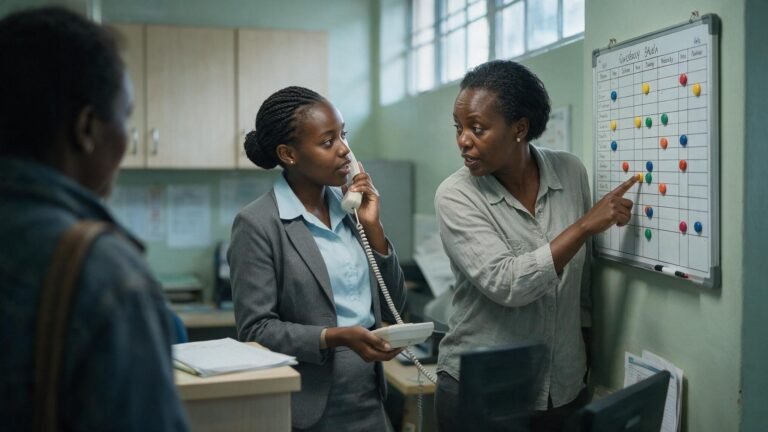

Photographs That Quietly Lose You the Sale
The photographs that lose sales on Kenyan business websites are rarely blurry or badly composed.
They are competent images that raise a question the page never answers. So a visitor cannot say what bothered them, and they leave anyway.
Six of them, and most sites carry at least two.
Photographs That Lose Sales, One: Stock Images
Four people in a glass-walled meeting room that is plainly not in Nairobi.
Visitors recognize stock imagery instantly, and the conclusion they draw is not neutral. If you will not show your actual premises, they wonder what your actual premises look like.
Photographs that lose sales most reliably are the ones showing a business other than yours.
Two: The Empty Business
Photographs of your space with nobody in it.
An empty salon, an empty restaurant, an empty workshop. Photographed clean and quiet, which felt professional at the time. It reads as closed, or unpopular, or no longer trading.
Show people working and customers present. Get permission for anybody identifiable.
Three: The Photograph From Four Years Ago
Old images cost you twice.
They date the business, and they misrepresent it. A customer arriving to find the premises renovated, the team changed, or the equipment different starts the relationship with a small correction.
For personal brands this matters more. A portrait from a decade ago makes the first meeting slightly awkward.
Four: The Detail That Contradicts You
The quietest of the photographs that lose sales.
A workshop image showing a cluttered bench on a page about precision. Perhaps a restaurant photograph with a dirty floor in the corner. Or a construction shot with workers not wearing safety equipment on a page about professionalism.
Nobody mentions it. Everybody sees it. Check the edges of every image before publishing.
Five: The One That Raises a Question
An image where the visitor cannot tell what they are looking at, which of the four people is you, or whether the product shown is the one described.
Each of these creates a small pause, and pauses accumulate into leaving. Caption anything ambiguous.
Six: The Heavy One
Technically excellent and several megabytes.
It never loads on mobile data, so the visitor sees a grey rectangle where your best work should be. Our post on why heavy pages lose Kenyan visitors covers the cost.
What Replaces Them
Photographs of your own work, your own premises, and your own people, taken in daylight recently.
A phone in good light beats a studio session in bad light. Shoot near a window, clear the frame of anything that does not belong, and take more than you need so you can choose.
Get written permission before publishing images of clients or customers. A photograph of an identifiable person is personal data, and our post on using images on your website legally covers the licensing side too.
Audit Yours This Afternoon
Open every page and look at each image with one question. What does this make a stranger wonder?
Where the answer is anything other than confidence, replace it. Where you cannot replace it yet, remove it, because a page with four honest photographs outperforms one with twelve that raise questions.
Frequently Asked Questions
Are photographs that lose sales always low quality? No. Most are technically fine and contextually wrong.
Is stock imagery ever acceptable? For abstract concepts, occasionally. Never for your premises, team, or work.
How recent should photographs be? Within two to three years, and sooner if anything visible has changed.
Do I need a photographer? Helpful, though a phone in daylight handles most of it.
How many images per page? Enough to answer questions, few enough to load fast.
What about images of customers? Written permission first, always.
Ask What Each Image Makes Them Wonder
Photographs that lose sales do it quietly, by raising doubts nobody articulates. Audit yours with that single question, and most of the problem will become obvious.
At Africa Web Experts we build around your real photographs rather than filling gaps with stock. From KES 65,000, live in seventy-two hours.