
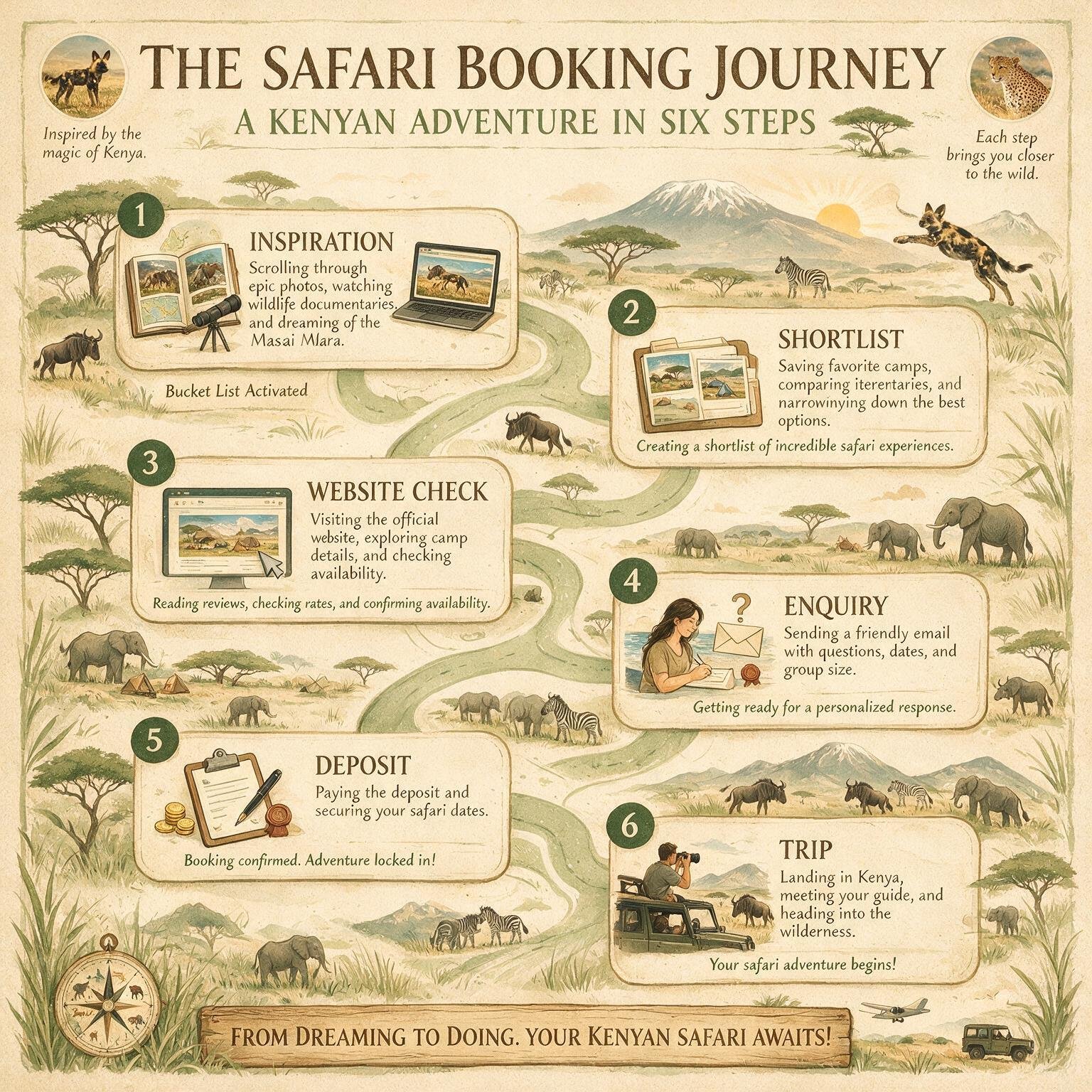
Safari Website in Kenya: What Actually Wins International Bookings
Someone in Munich is about to spend four thousand euros with a company they have never met, in a country they have never visited, based almost entirely on a website.
That is the transaction a safari website in Kenya has to close.
No other Kenyan business faces quite this problem. A Nairobi restaurant can rely on walk-ins. A SACCO serves members who already know it exists. A tour operator is asking a stranger eight thousand kilometres away to send a substantial deposit on trust alone.
This guide covers what actually builds that trust, why technical performance matters more for you than for almost any other Kenyan business, and where safari websites lose bookings they had already won.
Why Your Website Carries More Weight
Three things make tourism different from every other vertical.
Your customer cannot visit first. They cannot inspect your office, meet your guides or see your vehicles. Everything they will ever know about you before paying comes through a screen.
The purchase is large and irreversible. Safari bookings run into thousands of dollars, often with a non-refundable deposit. People research obsessively before committing that much, and they are actively looking for reasons to eliminate you.
You are competing globally. Your competitors are not only other Nairobi operators. They include international agencies with large marketing budgets, aggregator platforms, and operators in Tanzania and South Africa selling similar experiences.
Consequently, a website that would be perfectly adequate for a domestic Kenyan business is not adequate here.
Speed Matters More for You Than for Anyone Else
This deserves its own section, because it is the most commonly ignored issue in Kenyan tourism websites.
Safari sites are image-heavy by nature. Operators upload enormous, uncompressed wildlife photographs because the photographs are the product. Meanwhile the visitor is in Europe, North America or Australia, loading your site across intercontinental distance.
The result is a site that feels fine when tested in Nairobi and takes eleven seconds to load in Frankfurt. Travellers do not wait. They return to their search results and open the next operator.
Three fixes address most of it. Compress every image properly and serve modern formats such as WebP. Use a content delivery network so your pages are served from locations near your visitors rather than from a single server. Strip unnecessary scripts and plugins, which accumulate silently over years.
Test your site using tools that let you select a testing location abroad. Testing from Kenya tells you almost nothing about the experience your actual customers have.
The Trust Signals That Close Bookings
A first-time visitor is asking one silent question: is this company real and will my money be safe? Answer it explicitly.
Display your TRA licence. Tour operators in Kenya are licensed by the Tourism Regulatory Authority under the Tourism Act. Publish your licence details clearly. It is a regulatory requirement to hold one, and it is a powerful signal to a nervous foreign buyer.
Display KATO membership if you hold it. The Kenya Association of Tour Operators represents over 300 licensed operators and binds members to a code of conduct, with a bond scheme providing financial guarantees to clients. International travellers and overseas agents actively look for this. If you are a member, say so prominently. If you are not yet eligible, it is worth working towards.
Show your physical office and team. Real photographs of your premises, your named staff and your guides. Anonymous operators look like fronts.
Publish real reviews. Link to your independent review profiles rather than only quoting testimonials on your own page. Travellers trust third-party platforms far more than curated quotes.
Name your company properly. Full registered name, physical address, Kenyan phone number with country code, and a business email on your own domain. A Gmail address on a four-thousand-dollar transaction is a red flag to an overseas buyer.
Our guide to trust signals every website needs covers the general principles.
What a Safari Website in Kenya Must Contain
Detailed, honest itineraries
Not “7 Day Kenya Safari — Maasai Mara, Lake Nakuru, Amboseli.” That tells a traveller nothing.
Publish a genuine day-by-day breakdown. Where they sleep each night, named accommodation with its standard, driving distances and times, meals included, activities scheduled, and what free time looks like. Travellers compare itineraries line by line, and the operator with real detail wins against the one with a vague list of parks.
Transparent pricing
Publish prices, or at minimum publish clear ranges by season and group size.
Operators resist this, fearing they will be undercut. However, international travellers strongly prefer operators who show pricing, and many simply skip those who do not. State clearly what is included and — just as importantly — what is excluded. Park fees, international flights, visas, tips, drinks and travel insurance are the usual sources of dispute.
Seasonality guidance
Explain what different months actually deliver. Migration timing, calving season, rainfall, birding, crowd levels and price differences. This content answers real questions and attracts search traffic from travellers who have not yet chosen an operator.
Practical travel information
Visa and eTA requirements, vaccination guidance, currency and payment, what to pack, connectivity, tipping norms, safety. Be careful to keep this current and to point travellers to official sources for anything that changes, because outdated visa information damages trust badly.
Vehicles and guides
Photographs of your actual fleet, seating configuration, whether roof hatches are open-sided, and your guides’ qualifications and languages. This is a genuine differentiator that most operators bury.
Clear terms
Deposit amounts, payment schedule, cancellation policy, insurance requirements and what happens if plans change. Vague terms lose cautious buyers.
Enquiries and Payments
Make enquiring effortless. A short form asking for dates, group size, interests and budget beats a long form every time. Include WhatsApp, which many international travellers now use, and state your response time.
Then answer fast. In practice, response speed is one of the strongest predictors of conversion in this industry. A beautiful website with a three-day reply time loses to a plain website with a two-hour reply.
Handle time zones. Show your working hours in a way an overseas visitor can interpret, and set expectations if an enquiry arrives overnight.
Take deposits properly. Domestic customers use M-Pesa, and our guide to M-Pesa integration in Kenya covers that. However, international clients pay by card or bank transfer, so you need a gateway supporting international cards and multiple currencies. Note that some global processors do not support Kenyan businesses directly. See choosing the right payment gateway in Kenya.
Display prices in the currencies your clients think in. Most safari buyers reason in dollars, euros or pounds.
Photography and Content Rights
Two warnings, because both cause real problems.
Use your own photographs. Stock wildlife images appear on dozens of competing sites, and experienced travellers recognise them. Worse, some operators use images they have no licence to use, which creates genuine legal exposure. Your own trips are your best content library. See professional photography for websites.
Get consent before publishing client photographs. Guest images and testimonials require permission, and under Kenya’s Data Protection Act 2019 client details are personal data. If you publish photographs of local communities, obtain consent there too — this matters ethically as much as legally.
Speaking of which, you collect passport details, dates of birth, dietary requirements, medical information and payment details. Much of that is sensitive personal data. Read our guide to data protection for websites in Kenya.
Being Found by Travellers
Most safari bookings begin with a search months before the trip.
Write for the questions travellers actually ask. “Best time to see the migration,” “Maasai Mara vs Serengeti,” “is Kenya safe for families,” “how much does a Kenya safari cost.” These queries attract people at the research stage, which is when operators win relationships.
Consider language. A meaningful share of safari clients come from German, French, Italian and Spanish speaking markets. Translated content is a significant advantage, though it must be genuinely translated rather than machine-generated.
Build AI search visibility. Travellers increasingly ask AI assistants for operator recommendations. Being described accurately and cited in those answers is becoming a real channel. Our guide to AI search visibility in Kenya explains how.
Where Safari Websites Lose Bookings
Slow loading from overseas. The most common and most costly fault.
Vague itineraries. Losing to competitors who publish detail.
Hidden pricing. Travellers skip rather than enquire.
No licence or membership displayed. Nervous buyers need proof.
Stock photography. Experienced travellers spot it.
Outdated visa or park fee information. Damages credibility instantly.
Slow enquiry responses. The website did its job and the operator lost the sale.
No mobile optimisation. Many travellers research on phones even for expensive trips.
What It Costs and How Long It Takes
Simple business websites at Africa Web Experts start from KES 76,900. A safari operator site typically runs above that, because it carries detailed itinerary pages, heavy image optimisation, international payment handling and often multilingual content.
Cost drivers include the number of itineraries and destinations, whether online booking or deposit payment is included, translation requirements, and whether photography is part of the project.
Expect four to eight weeks. The bottleneck is usually itinerary content and photography rather than development, so gather both early.
For a wider breakdown, see getting a website in Kenya.
Frequently Asked Questions
Should a safari website publish prices? In most cases yes, or clear seasonal ranges. International travellers strongly prefer transparency and frequently skip operators who hide pricing.
Do I need to display my TRA licence on the website? Holding a valid Tourism Regulatory Authority licence is required to operate. Displaying it is not merely compliance signalling — it is one of the strongest trust signals available to a foreign buyer. Confirm current display and licensing requirements with the TRA.
Is KATO membership worth it for a small operator? Membership requires a valid TRA licence and a period of operation before applying, and it carries annual fees. For operators selling to international clients and overseas agents, the credibility and bond scheme are usually worth the cost.
How important is website speed really? For a business whose customers are overseas, it is among the most important technical factors. Test from your customers’ locations, not from Kenya.
Do I need a booking engine? Not necessarily. Many successful operators take enquiries and convert by email or WhatsApp, because safaris are consultative purchases. Online deposit payment matters more than full automated booking.
Should I translate my website? Consider it if you draw meaningfully from non-English speaking markets. Use professional translation rather than automated tools.
Building a Safari Website That Converts
Your website is doing something remarkable — persuading a stranger overseas to send thousands of dollars to a company they will not meet until they land. It needs to load fast from their side of the world, prove you are licensed and real, and answer every question they have before they think to ask it.
At Africa Web Experts, we build websites for Kenyan tour operators and travel businesses: fast international performance, detailed itinerary structures, multi-currency payment handling, and the credibility signals that turn overseas research into deposits.
If you are unsure how your site performs for a visitor in Europe or North America, that is the first thing worth measuring.